
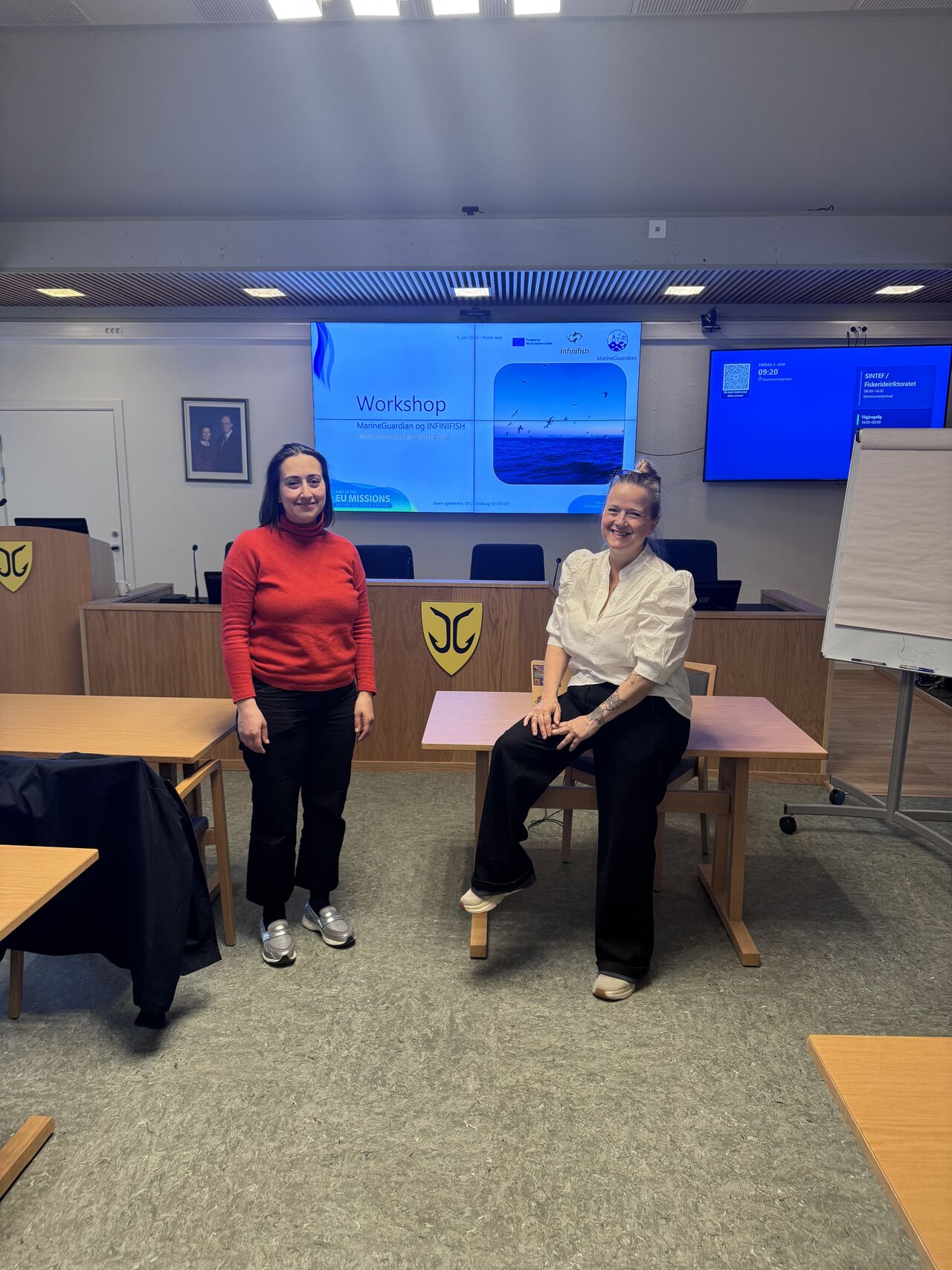
Reflections from the MarineGuardian stakeholder workshop in Myre, Northern Norway
At the beginning of June 2026, fishers, regulators, technology providers, and researchers from across Northern Norway gathered in Myre for a stakeholder workshop that brought together perspectives from both the MarineGuardian and Infinifish projects. The agenda covered automatic catch registration, onboard sensors, and machine vision systems capable of measuring and grading fish at sea. But the conversation that emerged went much further.
The central question the group was asked to explore: What would it take for fisheries technologies to be fully implemented across the fleet by 2040?
Working backwards from the future
To structure the discussion, participants worked through a backcasting exercise, starting from a shared vision of full technology adoption and tracing back the conditions that would need to be in place to get there. Eight drivers framed the analysis: regulations, markets, technology, research, industry, climate change, access to fishing areas, and social dynamics.
The exercise was facilitated by SINTEF Ocean’s Rachel Haug Fossback whose work on stakeholder engagement and technology adoption methodologies has shaped the approach taken throughout the MarineGuardian project; and Norwegian Directorate of Fisheries’ Pia Jonsson, who’s part of the external advisory group of the project.
Trust as a system requirement
If one theme defined the workshop, it was trust and the recognition that it cannot be engineered into a sensor.
Participants were clear: reliable data is not simply a matter of installing the right equipment. It requires knowing that all catch passes through the system, that the data cannot be manipulated, and that every actor in the chain, from fisher to buyer, is compensated correctly for what is actually landed. Trust is not a technical specification. It has to be designed into the entire system, from the vessel to the database to the regulatory framework.
This raised immediate questions about the role of Norway’s Metrology Service (Justervesenet), in a future where measurements are increasingly made by algorithms rather than certified weighing equipment. How these technologies should be independently tested, verified, and formally recognised remains an open and important question for regulators and technology developers alike.
Documentation at sea and the landing obligation
A related discussion focused on the landing obligation and what accurate at-sea documentation could mean for existing management and control systems. If catches can be reliably recorded at the point of capture, the implications for reporting, verification, and compliance are significant. But so are the evidentiary requirements: what data will be accepted, by whom, and under what conditions?
These are not purely technical questions. They require regulatory clarity, institutional readiness, and again trust between the parties involved.
Social dynamics as a driver in their own right
Perhaps the most important outcome of the workshop was the explicit recognition of social dynamics as a standalone driver of technology adoption, not a soft consideration to be addressed after the technical work is done, but a structural factor that shapes whether innovation takes root at all.
Participants highlighted that adoption depends on collaboration, peer learning, perceptions of fairness, quality of life at sea, and confidence that new systems will benefit those using them. Incentives were repeatedly raised as more effective than mandates: research quotas, reduced reporting burdens, and practical operational benefits were seen as far stronger drivers of uptake than regulatory requirements alone.
Why these conversations matter
The technologies being developed within MarineGuardian are maturing. Pilots are running. Data is being collected. But the path from trials to practice runs through questions that no algorithm can answer on its own.
Who verifies the data? Who owns it? Who benefits? Who is asked to change, and what do they get in return?
The workshop in Myre did not resolve these questions. It was not designed to. Its value lay in bringing the right people into the same room and making space for the harder conversations that technical development alone cannot have. That is precisely what stakeholder engagement in MarineGuardian is for.