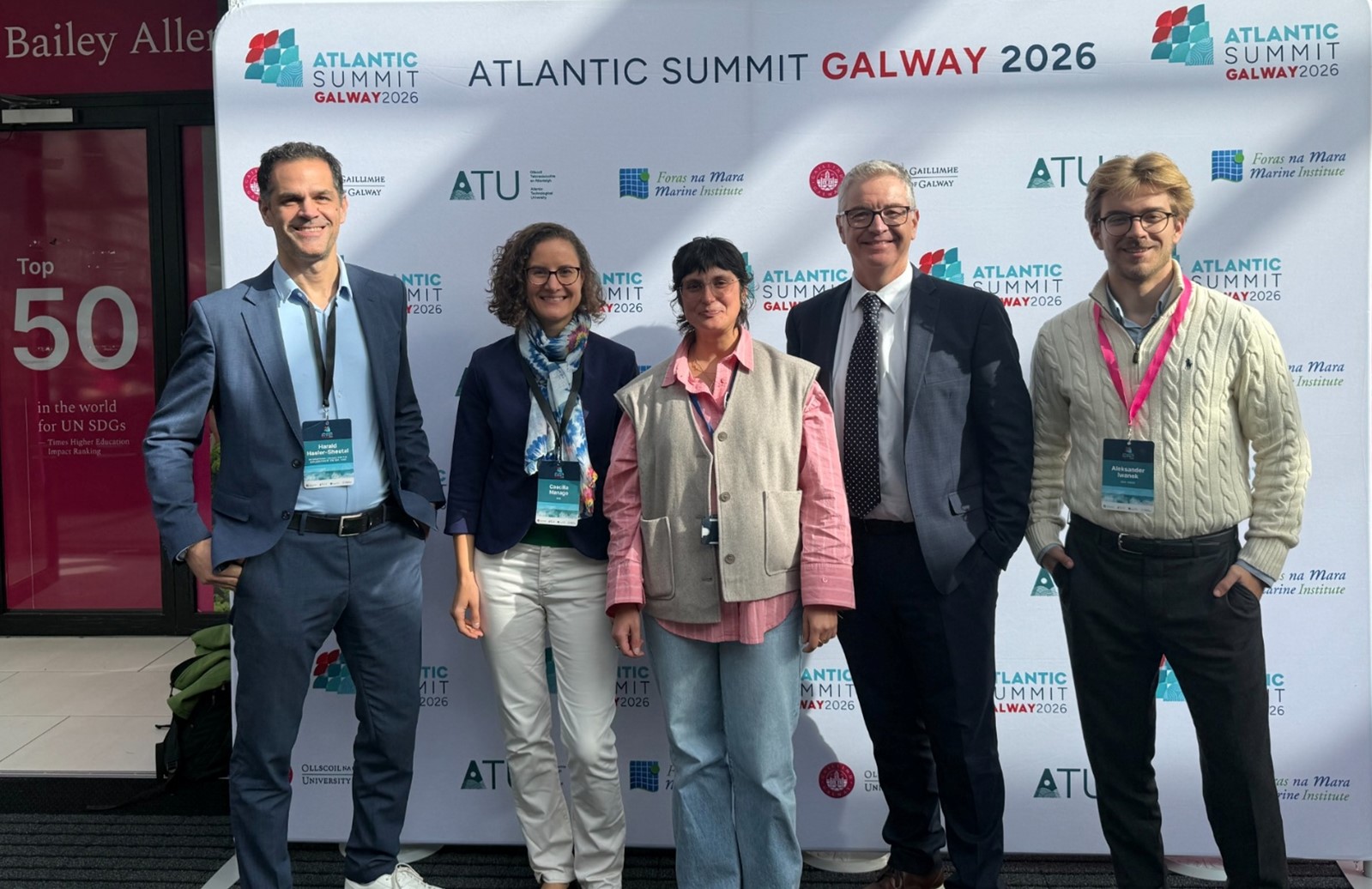
In October 2026, Caecilia Manago represented MarineGuardian at two events in Galway, Ireland: the North Atlantic Regional Dialogue for the UN Ocean Decade on 7 October, and the Atlantic Summit Galway 2026 on 8-9 October. Both dealt with how ocean research and shared priorities can lead to action.
Setting regional priorities for the Ocean Decade
The Regional Dialogue was held to help draft a regional Blueprint for the UN Ocean Decade, ahead of the 2027 Ocean Decade Conference. Stakeholders worked through four themes: ocean life, coastal resilience, ocean information and services, and ocean skills and participation. For each, the aim was to establish where action is most needed, which solutions already exist, what prevents them from being applied, and how organisations can work together to remove those barriers.
This is directly relevant to MarineGuardian. A bycatch-reduction technology that works in a trial still has to suit real fishing conditions, be accepted by the fishers who would use it, and be backed by governance and management arrangements. Without these, it is unlikely to be adopted once the project ends. The Dialogue was a place to raise these conditions with researchers, policymakers and fisheries stakeholders who shape the regional agenda.
The Atlantic Summit
The summit, organised by the Marine Institute, the University of Galway and Atlantic Technological University under the Irish Presidency of the Council of the EU, addressed biodiversity, ecosystem-based management, ocean research and international cooperation. These topics overlap with MarineGuardian’s work on protecting vulnerable species and supporting sustainable fisheries, and the summit gave the project a chance to place that work within the wider Atlantic policy discussion.
HOOK: from hackathon idea to fisher consultation
At the summit, Aleksander Iwanek presented HOOK, a proposed mobile decision-support application for small-scale fishers. The idea came from the All-Atlantic Intergenerational Hackathon in Brazil in 2026, which MarineGuardian supported, with ICES providing coaching. The app is meant to bring together information that fishers need for daily decisions: weather, ocean conditions, tides, vessel traffic, fuel costs and potential fishing areas. The presentation acknowledged support from MarineGuardian and BIOPROTECT.
HOOK was presented as an example of an idea that is still moving towards use. The next steps are to consult fishers, identify the most useful format and explore how existing services could be integrated. MarineGuardian continues to support this work and to link it with scientific and fisheries networks.
Sharing results through GEAR-UP
The events also raised the question of how results can be shared and sustained after a project ends. MarineGuardian contributes to GEAR-UP (Gear Up Towards Sustainable Fisheries), a UN Ocean Decade Action led by ICES under the Ocean Decade SMARTNET Programme. With ECO-CATCH and SEA4FUTURE, GEAR-UP supports the development, testing and uptake of fishing technologies that reduce bycatch and protect vulnerable species. The three projects share knowledge, coordinate engagement with fisheries stakeholders and connect solutions across sea basins, so that each builds on the others’ results. The approach and how to enhance its impact was discussed throughout the different events.