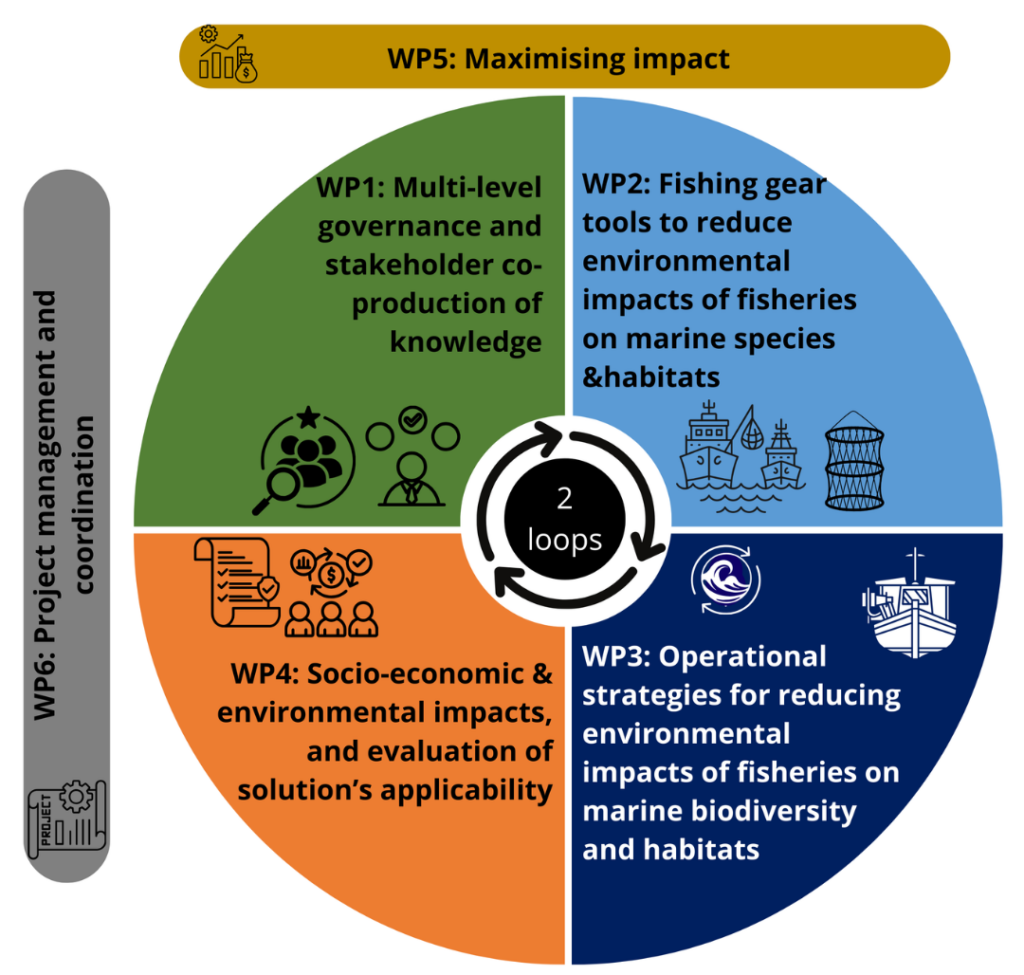
MarineGuardian is structured in 6 work packages (WP) through which the solutions will be developed. WP1 will act as the main WP for collaboration with stakeholders while WP2 and 3 will be the main solution developers. To reduce the environmental impact of fisheries on marine biodiversity and habitats, WP2 will focus on the tools while WP3 will focus on operational strategies. WP4 will act as the binder, analysing the socio-economic &environmental impact of the solutions while evaluating their applicability. Those WPs will go through a loop process where alpha and beta testing will be done.
The outcomes from this process will then feed into WP5 where the transfer of knowledge as well as the dissemination, communication and exploitation of the project will be done to maximise its impact.
WP1: Multi-level governance and stakeholder co-production of knowledge
WP1, led by Sintef Ocean, will facilitate stakeholder engagement during the project. It will analyse multi-level governance frameworks to identify barriers, synergies, and opportunities for holistic governance of fishing impacts on marine species and habitats. The WP also provides detailed information on CSs, the challenges, available solutions, and barriers for the uptake of mitigating measures.
Objectives
WP1 has 4 objectives:
- Characterisation of the case studies
- Mapping the areas of multi-level governance
- Facilitating stakeholder involvement, coordinating stakeholder outreach and events to maximise impact and avoid stakeholder fatigue
- Providing stakeholder mapping and develop strategy for stakeholder participation
WP2: Fishing gear & tools to reduce environmental impacts of fisheries on marine species & habitats
WP2, led by AZTI, will advance and demonstrate innovative, transferable and cost-effective fishing gears, tools & technologies to reduce the environmental impact of fishing practices.
Objectives
WP2 has the following objectives:
- Testing, advancing and demonstrating Bycatch Shield, a portfolio of deterrent technologies to reduce interactions between fishing gears and sensitive species
- Testing, advancing and demonstrating Catch Select, a portfolio of fishing gear modifications and technologies to reduce the capture of sensitive species and juvenile fish
- Testing, advancing and demonstrating Eco Gear, a portfolio of gear modifications to minimise negative impacts of fishing gears on marine habitats and reduce environmental footprint of fishing activity
WP outputs
This WP is one of the central WP producing the technical outcomes of the project. The deliverables linked to this WP can be found here. In this WP are also advanced three key exploitable results (KERs): Bycatch Shield, Catch Select and Eco Gear.
WP3: Operational strategies for reducing environmental impacts of fisheries on marine biodiversity and habitats
WP3, led by MFRI, will advance and demonstrate tools, technologies, and strategies to optimise fisheries and develop mitigation measures to protect sensitive species and vulnerable marine ecosystems.
This WP will also enhance knowledge on vulnerable species and habitats, incidental captures, spawning grounds, location of nursery grounds and recruitment processes. Those will be used to take decisions on temporal and/or spatial restrictions on fishing activities. It will also promote safe handling of bycaught species to reduce discard mortality.
Objectives
WP3 objectives are the following:
- Testing, advancing and demonstrating Catch Advisor, a portfolio of smart information system technologies
- Testing, advancing and demonstrating AI Decide: a portfolio of real-time AI and video tools and technologies to identify and avoid unwanted catches for sustainable fishing practices
- Testing, advancing and demonstrating Eco Guide, a portfolio of guidance tools on effecting beneficial changes in fishing operations and strategies
- Producing guidelines on safe handling to reduce discard mortality
- Producing best practice guidelines for implementing operational strategies for reducing environmental impacts of fisheries on marine biodiversity and habitats
WP outputs
This WP is the second central WP delivering the technical solutions of the project. The deliverables linked to this WP can be found here. In this WP are advanced three KERs: Catch Advisor, AI Decide and Eco Guide as well as one exploitable result: the best practices guidelines.
WP4: Socio-economic & environmental impacts, and evaluation of solutions’ applicability
WP4, led by Sjokovin, will provide evaluation and feedback on the applicability and efficacy of the innovative solutions advanced and demonstrated in WP2 and WP3, taking into consideration environmental, social, and economic impacts.
The WP will also analyse, demonstrate, and recommend how to increase value and promote sustainable seafood, thereby providing market incentives for improved fishing practices.
Objectives
WP4 objectives are the following:
- Evaluate the economic appraisal, and socio-economic & environmental impacts of the solutions developed by the project
- Realise the life cycle assessment of the solutions to quantify their environmental impacts and their effectiveness
- Explore value creation through sustainable seafood marketing and ecolabelling
- Identify how company rating schemes can create value
- Deliver a co-created methodological pipeline for EU taxonomy indicators
- Conduct an environmental cost-benefit analysis
WP outputs
This WP outputs will be used to evaluate which impact the solutions (advanced in WP2 and WP3) have both in regard with the socio-economic aspects and sustainability aspects, visible through the deliverables here. This WP will also advance two exploitable results: Incentives to overcome the barriers to adopt the solutions for the Marine Stewardship Council (MSC) certification, and a methodological pipeline to deliver EU taxonomy indicators from batch-based vessel level data.
WP5: Maximising impact
WP5, led by ICES, will facilitate dissemination, communication, training, and knowledge transfer of the project activities and its results, as well as integrating project outcomes into policy and practice, thereby maximising the impact of the project on society.
The WP will promote knowledge transfer, training and capacity building on matters concerning sustainable fisheries. It will also provide the means for integrating project results into policy, facilitate cooperation and support to parallel initiatives.
Objectives
WP 5 objectives support all the dissemination & communication activities from all the WPs:
- Publish a manual and legacy booklet form the project
- Allow capacity building, knowledge transfer & training through a structured approach involving the development of a MOOC
- Develop and run serious games where players will be given the roles of policymakers
- Ensure that the results of MarineGuardian are effectively integrated into policy frameworks, facilitating their scale- up and uptake by relevant stakeholders
- Facilitating liaison & support to parallel initiatives and policy implementation
WP outputs
This WP is the one ensuring the legacy of the project. It advances three KERs: Ocean Wisdom, MarineGuardian online manual and an action plan & roadmap for sustainable fisheries as well as exploitable results in the form of policy briefs. It is also the WP where all the communication materials are developed. Most deliverables associated to this WP are either legacy outputs or supporting documents.
WP6: Project management and coordination
WP6, led by Matís, will ensure overall coordination and management of the project.
The WP will facilitate the contractual, organisational, and financial responsibilities of MarineGuardian, ensure that exploitation and IPR issues are managed, maximised and protected, data managed and made available according to the Europeans Commission and consortium requirements, and that gender and ethical requirements are met.
Objectives
WP6 has the following objectives:
- Facilitate the administrative, financial and legal management of the project
- Facilitate the development and maintenance of an exploitation strategy for MarineGuardian results and provide an effective IPR strategy, management, and support
- Ensure that data is collected, processed, stored, and exploited according to EC requirements
- Ensure that the ethics requirements from the European Commission are followed
WP outputs
WP6 is the coordination WP and as such the outputs are deliverables around data management and ethics aspects. If you wish to know more about the data produced within MarineGuardian, you can check the dedicated page on the website or go check the Zenodo community.
