
Fisheries are increasingly expected to reduce bycatch, avoid sensitive marine habitats, and lower environmental impacts while maintaining viable operations. Achieving this requires advanced decision-support systems capable of integrating large volumes of environmental and operational data into actionable insights.
The Hafsýn DSS extension builds an end-to-end AI framework designed to support fleet optimisation, avoid bycatch and sensitive marine areas, and monitor environmental performance in real time.
The challenge
Modern fisheries generate vast datasets from vessels, environmental monitoring systems and catch records. However:
- Data is often fragmented across multiple systems
- Real-time integration is limited
- Environmental and operational indicators are rarely analysed together
- Bycatch risk and environmental impact are difficult to predict in advance
To effectively reduce impacts and optimise fishing strategies, fisheries need a fully integrated, scalable and validated AI pipeline.
The solution
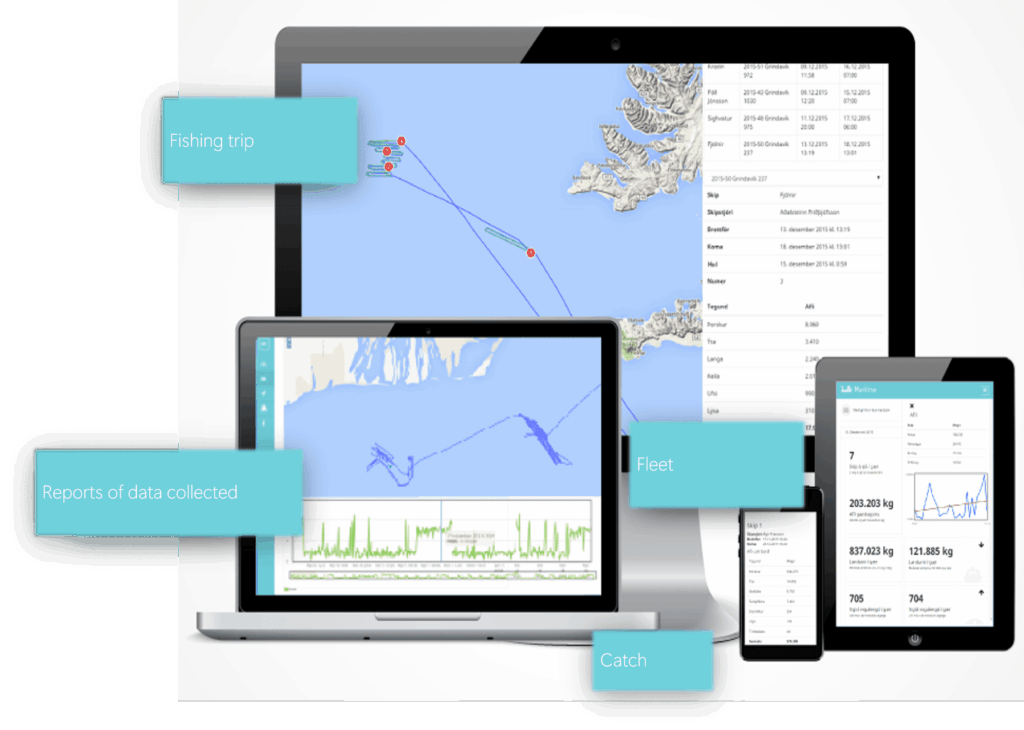
The Hafsýn DSS extension is built as an integrated data and AI framework that combines operational, environmental and fisheries data into a unified decision-support system.
Data integration
The system consolidates multiple onboard and environmental data sources, linking vessel activity, environmental conditions and catch records into a single structured workflow.
Data validation
Automated quality checks ensure that incoming data is complete, consistent and within reasonable bounds before being processed.
Data preparation
Raw data is transformed into structured, decision-ready inputs suitable for predictive modelling, ensuring that only relevant and operationally available information is used.
Model development
The system applies advanced machine learning models to analyse patterns in fishing activity and environmental conditions.
Predictive outputs
The framework generates key indicators, including:
- Expected catch performance
- Risk of bycatch
- Estimated environmental performance metrics
The system has been validated using real vessel data and is designed to scale progressively to broader fleet integration.
Development and progress
The Hafsýn DSS extension is already operational on real vessel data and continues to evolve.
Current status:
- Fully functional AI pipeline built and validated
- Operational on half a year of real data
- Designed to support both ongoing R&D and future Hafsýn integration
Next steps:
- Expand dataset coverage beyond current samples
- Integrate additional datasets and engineered features
- Implement CO₂-per-kg estimation
- Improve training performance of MLP and GRU models
- Move toward live data flow for both inputs and outputs
Expected impact
The Hafsýn DSS extension is expected to contribute to:
- Improved avoidance of bycatch and sensitive marine areas
- Reduced environmental footprint of fishing operations
- Data-driven optimisation of fleet strategies
- Enhanced transparency and monitoring capacity
- Scalable AI integration within commercial fleet management systems
By delivering an end-to-end AI framework, Hafsýn supports the transition towards smarter, lower-impact and more sustainable fisheries.
