
This solution is advanced by:

Reducing bycatch while maintaining efficient fishing operations remains a major challenge in mixed fisheries. In regions such as the Barents Sea, whitefish fisheries operate in complex ecosystems where catch composition can vary significantly by fishing ground.
The MarineGuardian Catchwise Decision Support System (DSS) aims to use artificial intelligence to predict catch composition in advance, supporting fishers in avoiding unwanted catches and reducing environmental impacts.
The challenge
Whitefish fisheries in the Barents Sea must balance economic performance with sustainability and regulatory requirements. However:
- Catch composition varies by location and season
- Fishers often lack real-time tools to anticipate bycatch risks
- Interactions with protected, endangered or threatened species (PETS) remain a concern
- Fishing activity may overlap with vulnerable marine habitats
Without predictive tools, avoiding unwanted catch and sensitive areas can be difficult.
The solution
Catchwise is developing AI-based algorithms to predict likely catch composition by fishing ground.
The system will:
- Provide estimated catch composition (species and size structure) before fishing
- Identify areas with higher likelihood of bycatch
- Support avoidance of protected, endangered and threatened species (PETS)
- Highlight potential interactions with safe versus vulnerable marine habitats
The solution will be delivered through the Catchwise DSS Extension, ensuring integration into existing workflows and adaptation among target users.
Development is carried out in collaboration with SINTEF, combining expertise in fisheries science, artificial intelligence and marine ecosystems.
Development and progress
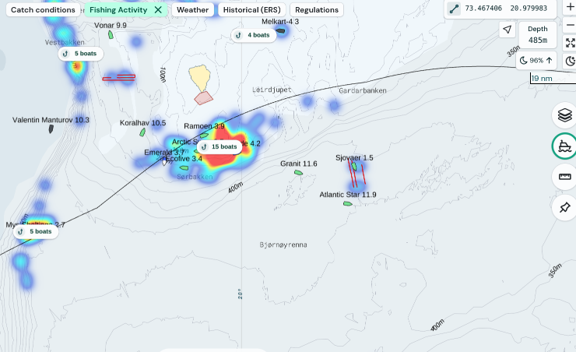
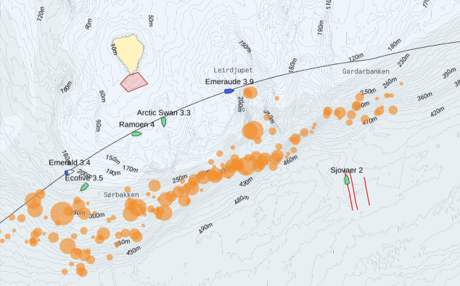
The Catchwise DSS extension is currently in the early development phase, despite having a fully functioning application already providing information regarding weather, catch conditions and fishing activity.
Progress to date:
- Conceptual framework defined for AI-based bycatch prediction in whitefish fisheries
- Key variables identified, including likely catch composition, species size distribution, and habitat vulnerability
Areas currently being explored include:
- Prediction of likely catch composition by fishing ground
- Avoidance modelling for PETS species
- Mapping of safe versus vulnerable marine habitats
Algorithm development and integration into the Catchwise DSS Extension are the next steps.
Expected impact
The Catchwise Decision Support System is expected to contribute to:
- Reduced bycatch through predictive avoidance
- Improved protection of PETS species
- Better spatial planning of fishing effort
- Reduced environmental impact in sensitive marine habitats
- More data-driven and proactive fishing strategies
By shifting from reactive to predictive decision-making, Catchwise supports more sustainable whitefish fisheries in the Barents Sea.
