
This solution is developed by:
Bottom trawl fisheries traditionally use rockhopper gear—a series of large rubber discs along the lower edge of the trawl—to help the net pass over uneven seabed. While effective at protecting the gear, rockhoppers can increase seabed contact, drag, and potentially the capture of undersized fish.
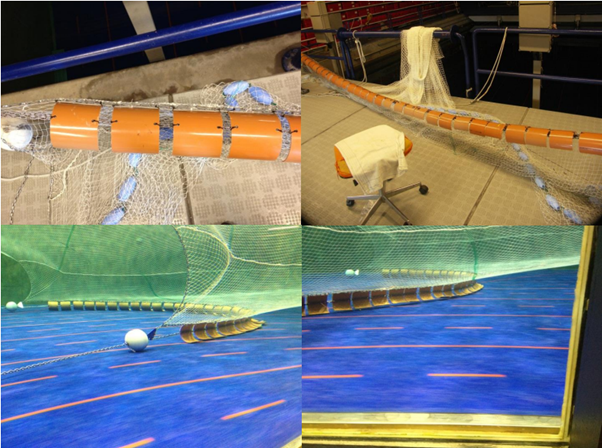
The semi-circular spreading gear (SCSG), a solution already advanced in other EU funded projects explores an alternative gear configuration designed to reduce seabed impact while maintaining effective trawl performance.
The challenge
Rockhoppers are widely used in bottom trawl fisheries because they allow the gear to roll over rough seabed. However, their design can increase the area of contact with the seabed, lead to higher drag and fuel consumption and affect catch composition, including the capture of undersized fish.
Semi-circular spreading gear offers a different approach to spreading and stabilising the trawl, but its environmental and fishing performance needs to be carefully evaluated and compared with conventional rockhopper gear.
The solution
This MarineGuardian solution focuses on testing and comparing semi-circular spreading gear (SCSG) as an alternative to traditional rockhopper trawls.
The approach aims to:
- assess differences in seabed contact and drag
- evaluate fuel use and associated emissions
- compare catch composition, including the capture of undersized fish
Using OptiGear, the project will analyse how SCSG performs and compare it to rockhoppers across multiple environmental and operational parameters, supporting evidence-based gear design decisions.
Development and progress
Development of the SCSG solution is currently focused on preparation and data collection:
- A data collection framework is being prepared
- Surveys have been sent to bottom-trawl captains to gather information on trawl rigging and gear configurations
- Discussions are ongoing to define the next trial phase, including further gear development and at-sea testing
Expected impact
The semi-circular spreading gear solution is expected to contribute to:
- Improved understanding of seabed impacts from different spreading gears
- Identification of gear configurations with reduced seabed contact and drag
- Support for gear choices that balance environmental performance and fishing efficiency
