
This solution is advanced by:

Discards and bycatch remain a critical challenge in demersal trawl fisheries in the West of Scotland, where cod and whiting stocks are in poor condition and mixed-species catches are common. In Nephrops fisheries, high levels of juvenile fish discards persist, while seal predation and the EU landing obligation add further operational and economic pressures on fishers.
The Smartrawl solution aims to minimise discards and avoid bycatch by enabling real-time, selective sorting of catch inside the trawl, before animals reach the codend. By addressing unwanted catch at the earliest possible stage, Smartrawl supports stock recovery, reduces waste, and helps fishers operate more efficiently under current regulatory constraints.
The challenge
Traditional trawl fisheries often rely on post-capture sorting on deck, which can lead to:
- High levels of discards
- Increased handling time and waste
- Reduced survival of released animals
- Challenges in meeting sustainability regulations
Reducing discards effectively requires selective solutions operating earlier in the fishing process, before unwanted catch is retained.
The solution
Smartrawl is an AI-driven, in-water sorting device retrofitted into the extension of a commercial trawl net. The system enables fishers to identify, size and selectively retain or release animals in real time, based on pre-defined criteria.
Smartrawl is composed of three integrated components:
- An underwater stereo camera that captures paired images of animals as they pass through the trawl
- A computer with artificial intelligence, which detects, identifies and sizes species in real time
- A patented rotating gate, controlled by the computer, which directs animals either towards retention or release
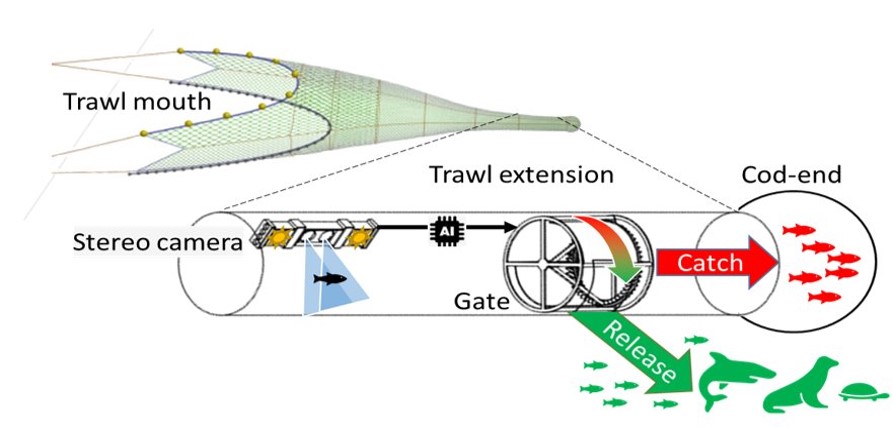
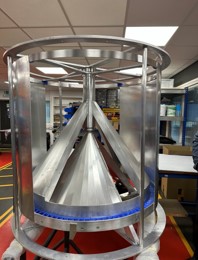
The system operates autonomously, without cables to the vessel, and can be pre-programmed by fishers according to their target species and sizes. By allowing unwanted catch to be released immediately, Smartrawl improves selectivity while maintaining fishing efficiency.
To learn more about Smartrawl – here is a video made for COP28
Development and progress
The development of Smartrawl is progressing through iterative testing under real fishing conditions:
- August 2025: manufacture of a new, more robust Smartrawl gate
- September 2025: preliminary trials in the Firth of Forth, demonstrating strong performance
- November–December 2025: testing done on a commercial trawler in the North Sea under the EU project MeCCAM
- 2026: continued trials planned in the West of Scotland as part of MarineGuardian
Expected impact
Smartrawl is expected to contribute to:
- Significant reduction in discards and bycatch of sensitive species (e.g. elasmobranchs and undersized fish)
- Improved stock health and recovery of vulnerable species
- Enhanced value of landed catch through higher selectivity
- Better compliance with sustainability regulations and certification schemes
- Reduced sorting time and waste handling onboard vessels
