
Solution advanced by

Bycatch of porpoises and other echolocating cetaceans remains a major challenge in gillnet fisheries. While acoustic deterrent devices (pingers) are commonly used to mitigate this risk, their implementation and long-term effectiveness can be challenging under commercial fishing conditions.
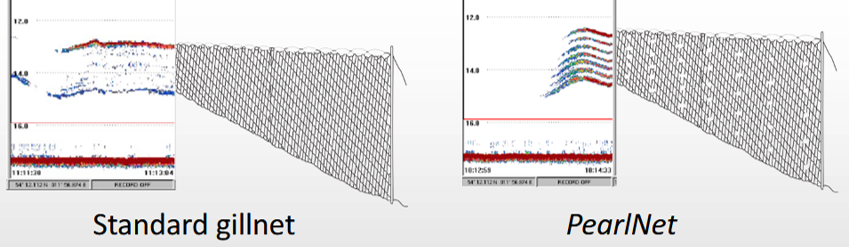
The MarineGuardian solution on acoustically visible gillnets, known as PearlNet, offers an alternative approach by enhancing the detectability of fishing gear, allowing cetaceans to perceive and avoid nets before entanglement occurs.
The challenge
Gillnets are difficult for echolocating cetaceans to detect, particularly in low-visibility conditions. Although pingers can reduce bycatch, they may present challenges related to deployment, maintenance, compliance, or long-term effectiveness.
There is a need for passive, gear-based solutions that reduce bycatch without relying on active sound emission.
The solution
PearlNet is a modified gillnet design that increases acoustic reflectivity, making the net more detectable to echolocating cetaceans such as porpoises. By improving the net’s acoustic “visibility,” the solution aims to:
- Enable cetaceans to detect nets earlier
- Reduce the risk of entanglement
- Maintain fishing efficiency and operational practicality
Development and progress
PearlNet builds on previous research and collaborative trials:
- Two experimental trials have already been conducted as part of the EU LIFE CIBBRiNA project, delivering promising results
- Additional trials are planned for 2027, focusing on testing PearlNet under commercial fishing conditions
Expected impact
The acoustically visible gillnet solution is expected to contribute to:
- Reduced bycatch of porpoises and other small cetaceans
- A robust alternative or complement to pingers
- Scalable mitigation measures for gillnet fisheries
