
This solution is developed by:

Identifying and quantifying what comes up in a fishing net (including protected species and indicators of vulnerable marine ecosystems) is one of the most demanding challenges in sustainable fisheries monitoring. BenthoSearcher 2.0 brings artificial intelligence and computer vision directly onto commercial vessels to meet this challenge at scale.
Built on the iObserver hardware platform, BenthoSearcher 2.0 is an advanced AI and computer vision tool designed to automatically detect, identify, and quantify benthic species, including Protected, Endangered and Threatened Species (PETS) and indicators of Vulnerable Marine Ecosystems (VMEs), with high accuracy, even in the complex and variable conditions of active fishing operations. When deployed on commercial vessels, the system delivers near real-time maps that support more sustainable fishing, help avoid unwanted catches, and enhance marine habitat cartography.
The challenge
Effective monitoring of benthic bycatch and habitat interactions requires continuous, accurate species identification across every haul. Current approaches face significant limitations:
- Human observers are costly, subject to fatigue, and cannot scale across entire fleets
- Post-hoc analysis of catch data fails to support real-time decision-making at sea
- Benthic species identification demands specialist expertise that is rarely available on board commercial vessels
- VME indicator species and PETS are frequently present in catches but go unrecorded, limiting the quality of data available to managers and regulators
The solution
BenthoSearcher 2.0 is positioned directly over the conveyor belt in the fishing sorting area on board commercial vessels. The system works by:
- Automatically capturing images of the entire catch during fish separation, without disrupting normal fishing operations
- Applying deep learning image recognition models to each image to identify species, estimate individual length and weight, and detect PETS and VME indicator species
- Combining outputs across all images from a haul to generate a comprehensive catch report, including quantification of benthic species and bycatch interactions
- Delivering near real-time spatial maps to support avoidance of sensitive habitats and unwanted catches
- Validating performance against human observer data across multiple fishing campaigns
The deep learning pipeline follows a structured workflow: iObserver images feed into image annotation, data preprocessing, model training, and evaluation, producing a robust, iteratively improved identification algorithm.
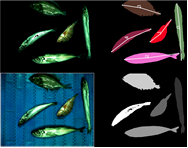
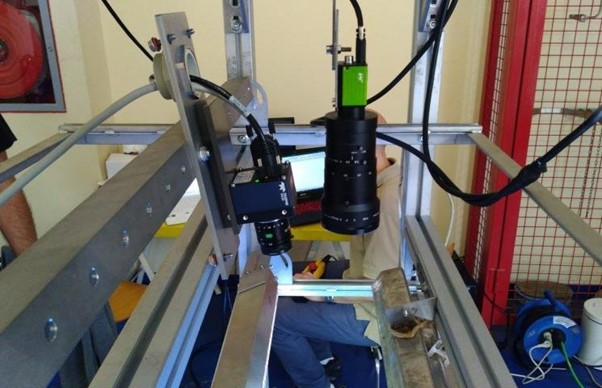
Target vessels and fisheries: BenthoSearcher 2.0 is primarily designed for fishing vessels equipped with onboard electronic monitoring (REM) systems, where catches are brought onboard and processed in areas that can be monitored with cameras. It is particularly applicable to demersal fisheries, including bottom trawls, longliners, and gillnets, where interactions with benthic organisms are most frequent. The system is intended to operate across a wide range of marine regions, with performance dependent on the availability of species-specific training datasets for the target fishing area.
Deployment prerequisites:
- Existing REM infrastructure (preferably iObserver)
- Adequate onboard power supply
- Catch sorting conducted under controlled lighting conditions
Note: BenthoSearcher 2.0 is not suited to pelagic fisheries, where benthic interactions are minimal.
Development and progress
The development of BenthoSearcher 2.0 is grounded in a rigorous, multi-stage data collection and AI training programme.
Dataset creation from electronic monitoring images: Real fishing operation images have been obtained from electronic monitoring systems on longline vessels of the Spanish fleet in the Bay of Biscay, in collaboration with the DataFish partner. Images capture interactions with benthic species across several ranges of visibility and environmental conditions, and are currently undergoing species validation.
Dataset creation from specimen samples (lab training sessions): Multiple training sessions have been conducted in the lab to feed the AI algorithms with high-quality labelled imagery. Specimens sourced from longline fishing gear, were photographed individually and in multi-species configurations, with and without overlap.
To maximise visual variety for AI training, each specimen was placed on a conveyor belt in multiple positions: ventral, dorsal, lateral, curved, straight, centred, near edges, perpendicular, and parallel. IIM-CSIC technicians recorded the size and weight of each photographed specimen. Current dataset summary: The training dataset now covers 133 specimens across 23 species, with a total of 1,402 photographs.
This work will be continued in the coming months comprising the training of the AI and increas eht enumbe rof pictures analysed.
Expected impact
BenthoSearcher 2.0 is expected to contribute to:
- Automated, scalable bycatch monitoring across commercial fleets, reducing reliance on costly human observer programmes
- Real-time detection of PETS and VME indicator species, supporting immediate operational decisions to avoid sensitive catches and habitats
- Enhanced marine habitat cartography, building spatial knowledge of benthic ecosystems from fleet-wide deployment
- Higher quality fisheries data for managers and regulators, with reduced observer bias and greater spatial and temporal coverage
- More sustainable fishing practices, by equipping fishers with actionable, real-time information at the point where it matters most
